Contact Information
Ready to Attend Our Next Event? Contact Us to Get Started Now!
Discover and attend our upcoming events. Call us now to reserve your spot and join the excitement!
For Sponsorship Sales
- Tausif Shaikh
- +971 58 593 9942
- tausif.shaikh@inoexglobal.com
For Speaking Slot
- Arif KP
- +971 55 661 0934
- arif@inoexglobal.com
Office Address
Office 30. 3rd floor, Rasis business center, Al Barsha 1, Dubai
Email Address
info@inoexglobal.com
Phone
+971 58 593 9942
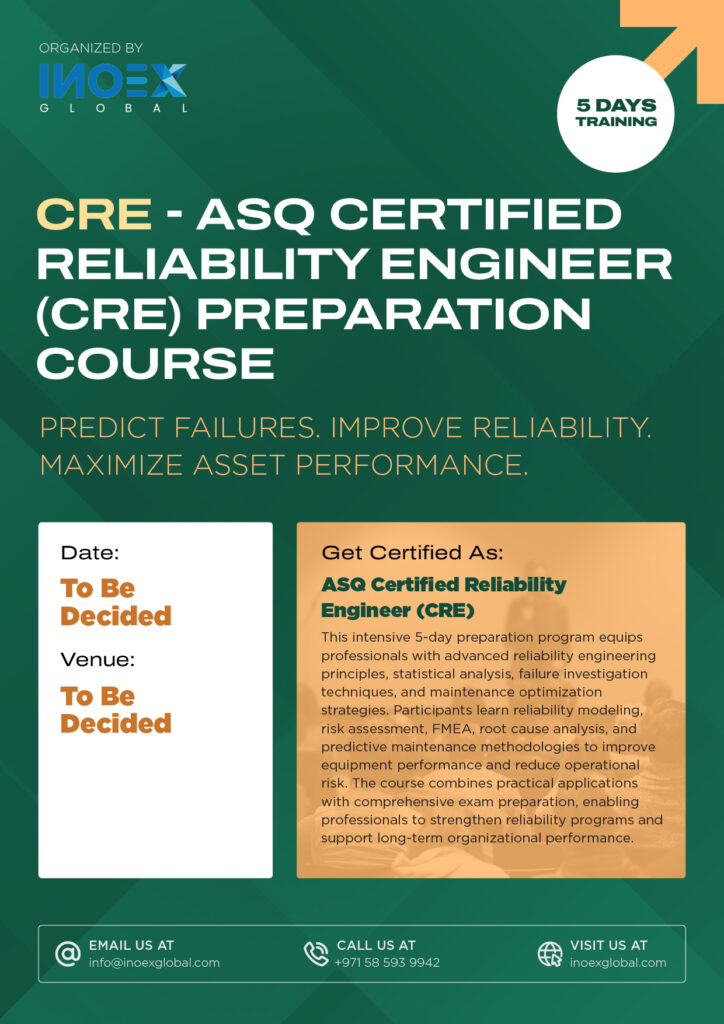
CRE – ASQ Certified Reliability Engineer (CRE) Preparation Course
Enroll in CRE
- TBD
- 5 Days
About this Program
Program Overview
The ASQ Certified Reliability Engineer (CRE) Preparation Course is an advanced professional development program designed to prepare engineers, maintenance professionals, quality practitioners, asset managers, and operational leaders for the globally recognized Certified Reliability Engineer (CRE) certification offered by the American Society for Quality (ASQ).
Reliability Engineering is a multidisciplinary engineering discipline focused on ensuring that systems, equipment, products, and processes perform their intended functions without failure under specified operating conditions for a defined period. In today’s highly competitive industrial environment, organizations must achieve higher equipment availability, lower maintenance costs, improved product quality, reduced operational risks, and enhanced customer satisfaction. Reliability Engineering provides the methodologies, analytical tools, and decision-making frameworks necessary to achieve these objectives.
The CRE certification is widely regarded as one of the most respected credentials in the fields of reliability engineering, asset management, quality engineering, maintenance excellence, operational excellence, and risk management. Certified Reliability Engineers are responsible for identifying potential failures before they occur, optimizing maintenance strategies, improving system reliability, reducing lifecycle costs, and enhancing organizational performance.
This course provides comprehensive coverage of the ASQ Certified Reliability Engineer Body of Knowledge (BoK), combining theoretical concepts, practical industrial applications, case studies, reliability calculations, examination preparation techniques, and real-world examples. Participants will develop the knowledge and skills required not only to successfully pass the CRE examination but also to implement reliability engineering practices that deliver measurable business results.
As industries increasingly adopt Industry 4.0 technologies, predictive maintenance systems, digital asset management platforms, and data-driven decision-making processes, the demand for qualified Reliability Engineers continues to grow globally. This training enables professionals to remain competitive and contribute strategically to organizational reliability and performance improvement initiatives.
Who Should Attend
Target Audience
- Reliability Specialists
- Asset Managers
- Plant Engineers
- Electrical Engineers
- Process Engineers
- Engineering Professionals
- Quality Engineers
- Operational Excellence Leaders
- Engineering Managers
- Production Managers
- Quality Managers
- Lean Manufacturing Professionals
- Asset Managers
- Manufacturing Engineers
Key Focus Areas
Reliability Engineering Fundamentals
- Reliability Definitions and Metrics
- Reliability Life Cycle Concepts
- Reliability Engineering Standards
- Reliability Program Planning
- Reliability Economics
- Availability and Maintainability Analysis
Probability and Statistics for Reliability
- Probability Theory
- Statistical Distributions
- Weibull Analysis
- Exponential Distribution
- Normal Distribution
- Reliability Data Analysis
- Statistical Process Control
- Confidence Intervals
- Hypothesis Testing
Reliability Modeling and Prediction
- Reliability Block Diagrams
- Fault Tree Analysis
- Reliability Prediction Models
- System Reliability Analysis
- Availability Modeling
- Reliability Growth Modeling
Failure Analysis and Risk Management
- Failure Modes and Effects Analysis (FMEA)
- Failure Modes Effects and Criticality Analysis (FMECA)
- Root Cause Analysis (RCA)
- Risk Assessment Methodologies
- Criticality Analysis
- Risk Prioritization
Reliability Testing
- Accelerated Life Testing
- Reliability Demonstration Testing
- Environmental Stress Screening
- Product Qualification Testing
- Reliability Verification Testing
Key Learning Objectives
Develop Reliability Programs
Design and implement structured reliability programs that align with organizational objectives and support long-term asset performance improvement.
Analyze Reliability Data
Collect, interpret, and utilize reliability data to identify trends, predict failures, and support evidence-based decision-making.
Apply Statistical Reliability Techniques
Use statistical tools and probability models to estimate reliability performance, predict failure behavior, and optimize maintenance planning.
Conduct Failure Investigations
Perform systematic failure investigations using recognized methodologies such as Root Cause Analysis, FMEA, and Fault Tree Analysis.
Improve Equipment Reliability
Identify opportunities to improve asset performance, increase equipment uptime, reduce maintenance costs, and extend operational life.
Optimize Maintenance Strategies
Evaluate and implement preventive, predictive, condition-based, and reliability-centered maintenance strategies.
Support Business Performance
Translate reliability engineering principles into measurable improvements in productivity, profitability, safety, and customer satisfaction.
Prepare for CRE Certification
Master the ASQ CRE Body of Knowledge and develop the confidence required to successfully pass the certification examination.
Benefits
Professional Benefits
Globally Recognized Credential Preparation
The CRE certification is recognized internationally as a benchmark of professional competence in reliability engineering.
Higher Earning Potential
Reliability engineering expertise is highly valued in asset-intensive industries, often leading to enhanced compensation and career advancement opportunities.
Leadership Development
Professionals become capable of leading reliability improvement initiatives and influencing organizational performance strategies.
Increased Career Opportunities
Organizations highly value professionals with expertise in reliability engineering, asset management, predictive maintenance, risk management, and operational excellence, often leading to advanced technical and leadership opportunities.
Stronger Technical Expertise
Participants develop practical skills in reliability modeling, statistical analysis, risk assessment, failure analysis, and maintenance optimization.
Future-Ready Skills
The course supports modern practices in Industry 4.0, digital transformation, smart manufacturing, predictive analytics, AI in maintenance, and Industrial Internet of Things (IIoT).
Organizational Benefits
Reduced Equipment Failures
Organizations can significantly reduce recurring failures through structured reliability engineering and maintenance optimization practices.
Increased Asset Availability
Improved reliability directly contributes to higher equipment uptime and operational continuity.
Lower Maintenance Costs
Reliability-based maintenance strategies reduce unnecessary maintenance activities and optimize resource utilization.
Improved Productivity
Reliable systems experience fewer disruptions, resulting in increased production capacity and improved throughput.
Enhanced Product Quality
Improved process reliability leads to more consistent product quality and reduced defects.
Better Risk Management
Organizations gain structured methods for identifying, evaluating, and mitigating operational risks before they impact business performance.
Improved Safety Performance
Reliability engineering helps prevent failures that could result in workplace injuries, environmental incidents, or regulatory violations.
Extended Asset Life
Organizations can maximize return on asset investments by extending equipment lifespan through proactive reliability practices.