Contact Information
Ready to Attend Our Next Event? Contact Us to Get Started Now!
Discover and attend our upcoming events. Call us now to reserve your spot and join the excitement!
For Sponsorship Sales
- Tausif Shaikh
- +971 58 593 9942
- tausif.shaikh@inoexglobal.com
For Speaking Slot
- Arif KP
- +971 55 661 0934
- arif@inoexglobal.com
Office Address
Office 30. 3rd floor, Rasis business center, Al Barsha 1, Dubai
Email Address
info@inoexglobal.com
Phone
+971 58 593 9942
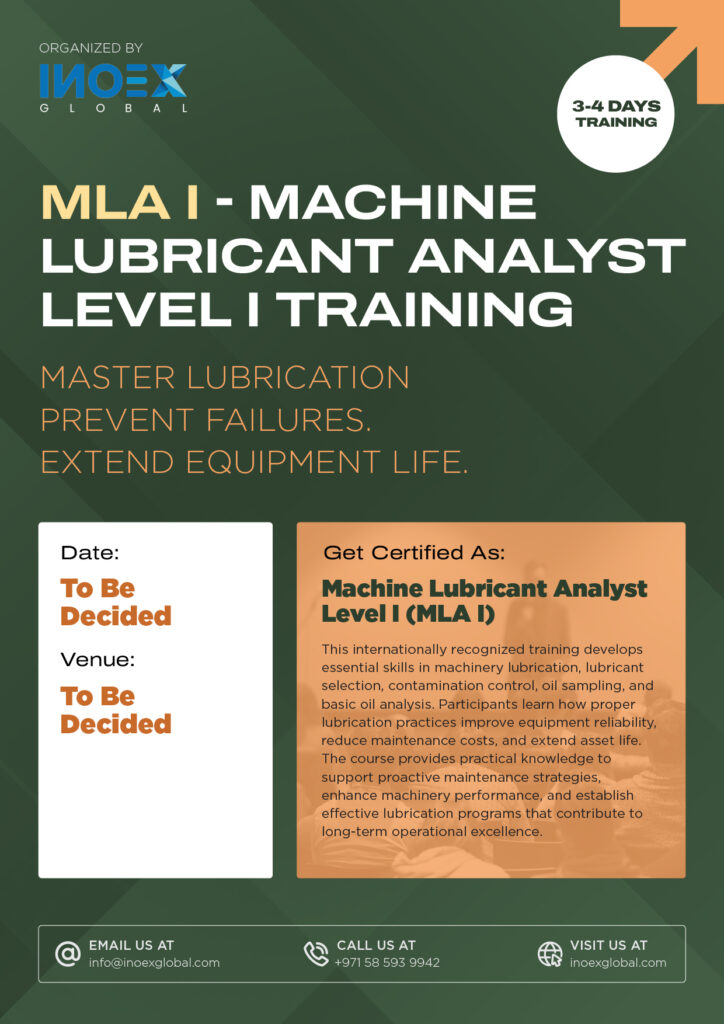
MLA I – Machine Lubricant Analyst Level I Training
Enroll in MLA I
- TBD
- 24–32 Hours / 3–4 Days
About this Program
Program Overview
The MLA I (Machine Lubricant Analyst Level I) Training is a globally recognized certification program designed for maintenance professionals, lubrication technicians, reliability engineers, condition monitoring specialists, and asset management personnel seeking to develop foundational expertise in machinery lubrication and oil analysis.
Lubrication is one of the most critical factors influencing equipment reliability, asset performance, and maintenance costs. Studies show that improper lubrication practices contribute significantly to premature bearing failures, gearbox damage, increased downtime, and reduced equipment life. MLA I certification provides professionals with the knowledge and practical skills needed to implement effective lubrication management programs and support proactive maintenance strategies.
This course introduces participants to lubrication fundamentals, lubricant selection, contamination control, oil sampling techniques, machine lubrication practices, and basic oil analysis concepts. Learners gain a solid understanding of how lubrication affects machine health and how proper lubricant management can improve equipment reliability, reduce maintenance costs, and extend asset life.
The training aligns with international best practices in lubrication excellence and reliability-centered maintenance, making it an essential qualification for professionals involved in machinery maintenance and asset reliability.
Who Should Attend
Target Audience
- Lubrication Technicians
- Maintenance Technicians
- Mechanical Engineers
- Reliability Engineers
- Maintenance Supervisors
- Plant Engineers
- Condition Monitoring Professionals
- Asset Management Personnel
- Predictive Maintenance Specialists
- Operations Personnel
- Rotating Equipment Engineers
- Reliability Coordinators
- Production Engineers
- Maintenance Planners
- Industrial Technicians
Key Focus Areas
Lubrication Fundamentals
- Functions of lubricants in machinery
- Friction and wear mechanisms
- Lubrication regimes
- Lubricant properties and characteristics
Lubricant Selection
- Oil and grease selection criteria
- Viscosity fundamentals
- Base oils and additives
- Manufacturer recommendations
Contamination Control
- Particle contamination management
- Water contamination prevention
- Air and chemical contamination control
- Cleanliness standards
Oil Sampling and Analysis
- Sampling best practices
- Sample handling procedures
- Oil condition monitoring
- Basic oil analysis interpretation
Machinery Lubrication Practices
- Bearing lubrication
- Gearbox lubrication
- Hydraulic system lubrication
- Electric motor lubrication
Reliability Improvement
- Lubrication program development
- Preventive maintenance support
- Asset reliability enhancement
- Lubrication excellence implementation
Course Modules
01
MODULE
Lubrication Fundamentals
Participants learn:
- Principles of friction and wear and how they impact machinery performance and component life.
- Lubrication mechanisms that reduce friction, minimize wear, and improve equipment efficiency.
- Lubricant functions including cooling, cleaning, sealing, and protecting machine components.
- Lubrication regimes and film formation to ensure effective separation of moving surfaces.
02
MODULE
Lubricant Types and Properties
The course covers:
- Mineral oils and synthetic lubricants and their suitability for different operating conditions.
- Grease composition and characteristics for selecting the right grease application.
- Viscosity measurement and selection to ensure optimal lubricant performance.
- Lubricant additives and performance enhancement for improved protection and reliability.
03
MODULE
Lubricant Selection and Application
Participants explore:
- Selecting the right lubricant for machinery based on equipment requirements and operating environments.
- Matching lubricant properties to operating conditions such as temperature, load, and speed.
- Manufacturer specifications and requirements to maintain equipment warranty and performance.
- Lubrication frequency and scheduling to prevent over-lubrication and under-lubrication issues.
04
MODULE
Contamination Control
Learners develop knowledge of:
- Particle contamination effects and their role in accelerating machine wear.
- Water contamination risks that can degrade lubricant quality and damage equipment.
- Airborne contaminants and methods to prevent their entry into lubrication systems.
- Filtration technologies used to maintain lubricant cleanliness and system reliability.
- Lubricant storage and handling best practices to preserve lubricant integrity and performance.
05
MODULE
Oil Sampling Techniques
The training includes:
- Proper sampling methods to obtain accurate and reliable oil analysis results.
- Sampling equipment selection for safe and representative sample collection.
- Representative sample collection techniques that reflect actual machine conditions.
- Sample labeling and documentation to ensure traceability and analysis accuracy.
- Avoiding sampling errors that can lead to incorrect maintenance decisions.
06
MODULE
Introduction to Oil Analysis
Participants learn:
- Oil analysis objectives and their importance in predictive maintenance programs.
- Basic lubricant condition assessment to determine lubricant health and usability.
- Wear debris monitoring for early detection of component deterioration.
- Contamination identification to recognize sources of lubricant degradation.
- Lubricant health evaluation to support informed maintenance planning.
07
MODULE
Machinery Lubrication Practices
The course addresses:
- Bearing Lubrication
- Grease application techniques that ensure adequate lubrication without excess grease buildup.
- Relubrication intervals based on operating conditions and equipment requirements.
- Bearing protection strategies to maximize bearing life and reliability.
- Gearbox Lubrication
- Gear lubricant selection for effective protection against wear and extreme loads.
- Lubrication methods that ensure consistent lubricant distribution within gear systems.
- Gear wear prevention through proper lubricant management and monitoring.
- Hydraulic Systems
- Hydraulic fluid management to maintain system efficiency and performance.
- Fluid cleanliness requirements that reduce component wear and system failures.
- System reliability improvement through effective hydraulic lubrication practices.
- Electric Motors
- Motor bearing lubrication techniques that support smooth and reliable operation.
- Lubrication frequency optimization to balance protection and maintenance efficiency.
- Common lubrication-related failures and methods to prevent them.
08
MODULE
Lubrication Program Development
Participants learn how to:
- Establish lubrication routes that ensure all critical assets receive proper attention.
- Create lubrication schedules aligned with equipment operating requirements.
- Implement lubrication best practices to improve maintenance effectiveness and reliability.
- Improve lubrication management systems for long-term asset performance and operational excellence.
Key Learning Objectives
Technical Competencies
- Understand the role of lubrication in machine reliability
- Identify lubricant types and applications
- Select appropriate lubricants for industrial equipment
- Implement proper lubrication practices
- Recognize common lubricant degradation mechanisms
- Understand contamination sources and control methods
- Perform effective oil sampling procedures
- Support oil analysis programs
Maintenance Competencies
- Reduce lubrication-related equipment failures
- Improve machinery performance and efficiency
- Support preventive and predictive maintenance initiatives
- Extend equipment service life
- Enhance maintenance planning activities
Reliability Competencies
- Improve asset availability and reliability
- Support reliability-centered maintenance programs
- Contribute to lubrication excellence initiatives
- Reduce maintenance costs through proactive lubrication management
Professional Development
- Build foundational lubrication expertise
- Strengthen maintenance and reliability skills
- Improve troubleshooting capabilities
- Enhance career opportunities in maintenance and reliability fields
Benefits
Risk & Governance Competencies
Internationally Recognized Certification
MLA I certification demonstrates foundational competency in lubrication management and machine reliability improvement.
Increased Employability
Organizations increasingly seek certified lubrication professionals who can reduce equipment failures and improve asset performance.
Enhanced Technical Expertise
Professionals gain practical knowledge in lubricant selection, oil analysis, contamination control, machinery lubrication, and reliability improvement strategies.
Career Advancement Opportunities
Certified professionals are highly valued across industries including manufacturing, oil & gas, power generation, mining, cement, steel, pharmaceuticals, automotive, petrochemicals, and food processing, where equipment reliability and maintenance excellence are critical.
Organizational Benefits
Reduced Equipment Failures
Proper lubrication practices significantly decrease lubrication-related failures and unplanned downtime.
Extended Asset Life
Proper lubrication reduces wear, minimizes damage, and increases machinery lifespan.
Enhanced Safety and Sustainability
Well-maintained equipment operates more safely and efficiently while reducing environmental impact.
Improved Maintenance Effectiveness
Organizations can implement proactive maintenance strategies that focus on preventing failures before they occur.