Contact Information
Ready to Attend Our Next Event? Contact Us to Get Started Now!
Discover and attend our upcoming events. Call us now to reserve your spot and join the excitement!
For Sponsorship Sales
- Tausif Shaikh
- +971 58 593 9942
- tausif.shaikh@inoexglobal.com
For Speaking Slot
- Arif KP
- +971 55 661 0934
- arif@inoexglobal.com
Office Address
Office 30. 3rd floor, Rasis business center, Al Barsha 1, Dubai
Email Address
info@inoexglobal.com
Phone
+971 58 593 9942
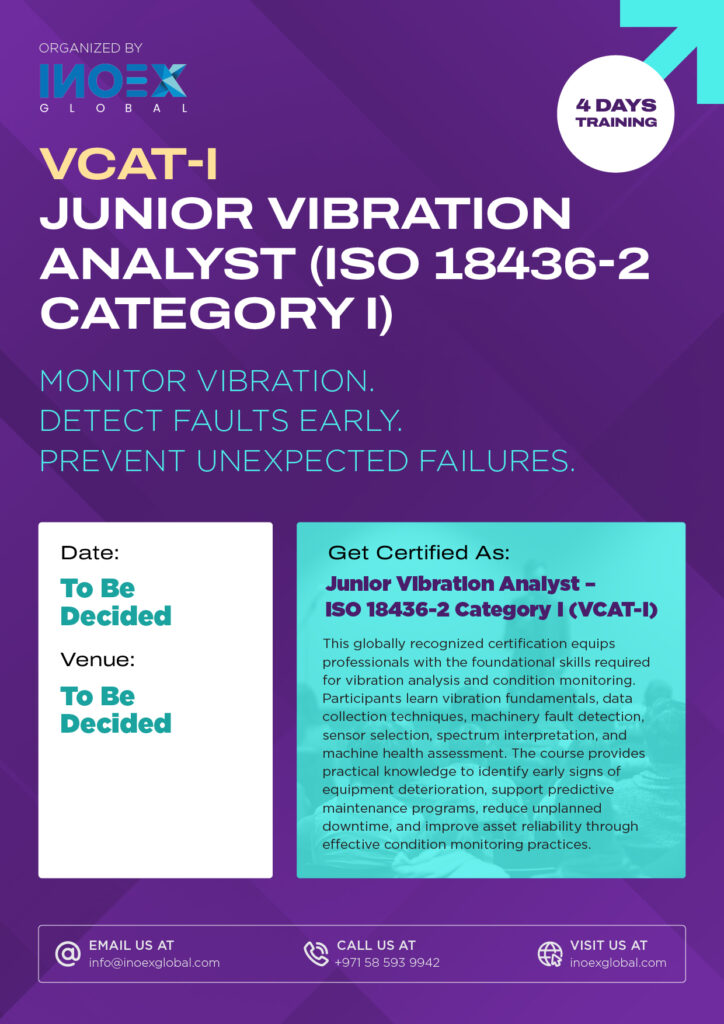
VCAT-I — Junior Vibration Analyst
Enroll in VCAT-I
- TBD
- 32+ Hours / 4 Days
About this Program
Program Overview
The VCAT-I (Vibration Category Analyst Training — Level I) is the globally recognised entry-level programme for professionals beginning their journey in machinery vibration analysis and condition monitoring. Developed in alignment with ISO 18436-2, it is the industry’s foundational standard for vibration analyst competency.
In asset-intensive industries — manufacturing, oil & gas, power generation, petrochemicals, and utilities — machinery failure costs billions annually in unplanned downtime, safety incidents, and reactive repairs. Vibration analysis is the most powerful predictive maintenance technology available, detecting developing faults in rotating machinery weeks or months before failure occurs.
VCAT-I equips professionals with the core knowledge and practical skills needed to collect quality vibration data, identify early signs of machine deterioration, and contribute meaningfully to their organisation’s condition monitoring programme.
Upon successful completion, candidates are eligible to sit the Mobius Institute Board of Certification (MIBoC) examination — accredited to ISO/IEC 17024, the highest possible standard for personnel certification.
Who Should Attend
Target Audience
- Maintenance Technicians & Engineers
- Reliability & Asset Management Professionals
- Engineering Graduates & New Entrants
- Condition Monitoring Technicians
- Plant Operators & Production Staff
- Those Seeking Formal ISO Certification
Key Focus Areas
Condition Monitoring Fundamentals
An overview of the full condition monitoring landscape — vibration alongside thermography, oil analysis, ultrasound, and motor current analysis in a world-class reliability programme.
Vibration Physics & Signal Theory
Core concepts: waveforms, frequency spectra, amplitude metrics (RMS, peak, peak-to-peak, crest factor), and how machinery motion translates into measurable vibration signals
Data Collection & Measurement Quality
How to take dependable, repeatable, high-quality vibration readings. Sensor selection, placement, mounting techniques, route planning, and avoiding common measurement errors.
Machinery Knowledge & Equipment
How common rotating machines work — motors, pumps, fans, gearboxes, compressors, belt drives — and how their mechanical design influences vibration signatures.
Basic Fault Detection & Analysis
Recognising vibration signatures of the most common faults: rolling element bearing deterioration, unbalance, misalignment, mechanical looseness, and early resonance indicators.
Analyser Settings & Alarm Management
Correctly configuring key analyser parameters — Fmax, LOR, averaging, ICP power — and setting meaningful alarm levels to trigger appropriate maintenance actions.
Course Modules
01
Introduction to Condition Monitoring & Reliability
The course opens with a clear business context — explaining how condition monitoring reduces maintenance costs, prevents catastrophic failures, improves safety, and extends asset life. Learners understand where vibration analysis sits within the P-F (Potential Failure) curve and why early detection matters. Key condition monitoring technologies are introduced and compared, giving learners a holistic view of the predictive maintenance toolkit.
02
Vibration Theory & Physics Fundamentals
Learners develop a thorough grounding in the physics of vibration: displacement, velocity, and acceleration. Time waveform interpretation, FFT (Fast Fourier Transform) spectra, and simple amplitude metrics — RMS, peak, peak-to-peak, and crest factor — are explained clearly using 3D animations and interactive simulations. The Nyquist theorem, aliasing, and signal windowing are also introduced as essential analyser concepts.
03
Vibration Sensors: Types, Selection & Mounting
Learners understand how accelerometers, velocity transducers, and proximity probes work; their frequency response ranges and appropriate applications; and the critical importance of correct mounting technique. Stud mounting, adhesive, magnetic base, and handheld probe methods are all covered — with their impact on data quality demonstrated through practical simulation exercises.
04
Machinery Knowledge: Understanding the Equipment
A dedicated section covering how the most common rotating machines operate mechanically: motors, centrifugal pumps, fans, gearboxes, belt-drive systems, and compressors. Learners see how design features like bearing types, gear ratios, and blade counts directly appear as frequency components in the vibration spectrum — making this the foundation of fault diagnosis.
05
Data Collection: Routes, Procedures & Quality Assurance
Learners master the discipline of structured vibration data collection: defining measurement points, establishing monitoring routes, configuring collector settings (Fmax, LOR, averaging), and applying consistent measurement procedures. Emphasis is placed on repeatability — because trending over time is only meaningful when measurements are taken identically each time.
06
Common Fault Detection: Analysis Fundamentals
Learners are introduced to the spectral signatures of the most prevalent rotating machinery faults. Rolling element bearing faults (using BPFO, BPFI, BSF, FTF frequency calculations), mass unbalance (1x synchronous vibration), shaft misalignment (1x and 2x components), mechanical looseness patterns, and early resonance indicators. By the end of this module, learners can identify these faults confidently in real vibration spectra.
07
Alarm Setting, Reporting & Exam Preparation
The final module covers overall level alarms, spectral band alarms, and mask alarms — and how to set meaningful alert and danger thresholds based on ISO 10816/20816 severity standards. Learners also practise communicating findings through structured condition reports. The module closes with comprehensive exam preparation: worked examples, practice questions, and a full mock examination to build confidence for the MIBoC certification exam.
Key Learning Objectives
- Explain the business case for condition monitoring and vibration analysis within a broader reliability-centred maintenance strategy
- Describe vibration fundamentals: waveforms, frequency spectra, amplitude metrics, and the relationships between time and frequency domain data
- Select appropriate vibration sensors (accelerometers, velocity transducers) for different machine types, speeds, and measurement locations
- Mount vibration sensors correctly and safely to obtain high-quality, reliable, and repeatable measurements every time
- Configure data collector / analyser settings (Fmax, LOR, averaging, windowing) to capture the right data for the machine type being monitored
- Execute structured vibration measurement routes to collect consistent, high-quality data across an asset population
- Identify key spectral features and patterns associated with rolling element bearing faults, unbalance, misalignment, and mechanical looseness
- Validate vibration data quality, identify corrupted measurements, and understand when to re-collect data before reporting findings
- Understand overall vibration alarm levels and band alarms, and use them to flag machines that require further investigation or maintenance action
- Communicate machinery health findings clearly to supervisors, senior analysts, and maintenance planners using appropriate technical language
- Describe the basic operation of common rotating equipment (motors, pumps, fans, gearboxes) and correlate their mechanics to vibration signatures
- Prepare for and confidently sit the ISO 18436-2 Category I certification examination administered by MIBoC (Mobius Institute Board of Certification)
Benefits
Professional Benefits
Globally Recognised ISO Certification
Earn the ISO 18436-2 Category I credential — the international benchmark for vibration analyst competency, recognised across oil & gas, manufacturing, power, and utilities sectors worldwide
Career Entry & Advancement
VCAT-I is the mandatory first step in the VCAT I-IV career pathway. It opens roles such as Vibration Technician, CM Analyst, and Reliability Technician — with a clear route to VCAT-II and beyond
Increased Earning Potential
Certified vibration analysts command significantly higher salaries than uncertified counterparts. Certification proves measurable competency, making you a preferred candidate in a competitive job market
Deep Technical Confidence
Move from guesswork to evidence-based analysis. You will understand why machinery behaves the way it does and have the vocabulary to communicate findings with authority.
Join a Global Professional Community
MIBoC certification connects you with thousands of certified vibration analysts worldwide — a professional network spanning every major industrial sector and geography.
Immediate On-the-Job Impact
Skills learned on Day 1 apply on Day 5. The course is designed to be immediately practical — you will return to your plant better equipped to collect data, spot issues, and prevent failures.
Organizational Benefits
Reduced Unplanned Downtime
Trained analysts detect developing faults weeks or months before failure. This transforms reactive emergency repairs into planned maintenance interventions — dramatically reducing costly unplanned production stops
Improved Plant Safety
Unexpected machinery failure is a leading cause of workplace injuries. Early fault detection prevents catastrophic failures that endanger personnel and damage critical plant infrastructure
Extended Asset Life
Organisations with structured vibration programmes operate machinery at peak efficiency for longer. Certified analysts ensure problems are caught at the earliest stage — before secondary damage occurs.
Regulatory & Standards Compliance
ISO 18436-2 certified teams demonstrate verifiable competency to auditors, regulators, and insurance assessors — supporting compliance with ISO 55000 (Asset Management) and industry-specific standards.
Building Internal Capability
VCAT-I develops in-house vibration competency. A team progressing from VCAT-I to VCAT-III reduces dependence on expensive external contractors for condition monitoring services
Measurable ROI on Training Investment
Industry data shows predictive maintenance programmes deliver 10:1 return on training investment through avoided failures, reduced spare parts consumption, and optimised maintenance labour deployment
VCAT-I vs Other Vibration Training Options
Not all vibration training is equal. VCAT-I aligned to ISO 18436-2 delivers an internationally accredited, career-structured, and practically grounded qualification that generic alternatives simply cannot match
| Feature | VCAT-I (ISO 18436-2) | Generic Online Courses | In-House OJT Only | Other Programmes |
|---|---|---|---|---|
|
International ISO Accreditation |
ISO 18436-2 + ISO/IEC 17024 |
None |
None |
Not applicable |
|
MIBoC (Mobius Institute) |
Self-issued only |
None |
Internal credential |
|
|
Structured Curriculum Standard |
ISO 18436-3 compliant |
Varies by provider |
Ad hoc |
Platform dependent |
|
Formal Certification Exam |
60 MCQ · 2hrs · 70% pass |
Quiz/completion only |
None |
Varies |
|
Global Industry Recognition |
Recognised in 50+ countries |
Limited recognition |
Site-specific only |
Sector-specific |
|
Machinery Fault Detection Content |
Comprehensive — 6+ fault types |
Basic overview |
Machine-specific only |
Not covered |
|
Career Pathway Integration |
VCAT-I → II → III → IV |
Standalone only |
No formal pathway |
Limited vertical |
|
Pre & Post Course Access |
Up to 8 months total |
Varies |
None |
12 months typical |